 CelebMaker
Put a plain-language disclosure next to the portrait and keep a copy in your delivery note. Signed Content Credentials can show parts of a file’s creation and editing history when available. A person seeing a repost may only see the pixels and caption.
Describe the actual edit in one line
For a fictional exhibit guide, write “AI-generated illustration of a fictional adult guide.” For a consented staff photo with a replaced background, write “Photograph with an AI-generated background.” These statements identify different operations. A caption such as “created with AI” is too broad if the reader needs to know whether the face itself is synthetic.
Keep the note with the exact file you send. Name one file “guide-illustration-v03” and a cropped derivative “guide-illustration-v03-square.” If a recipient is preparing an image card, give them a caption short enough to keep beside the image.
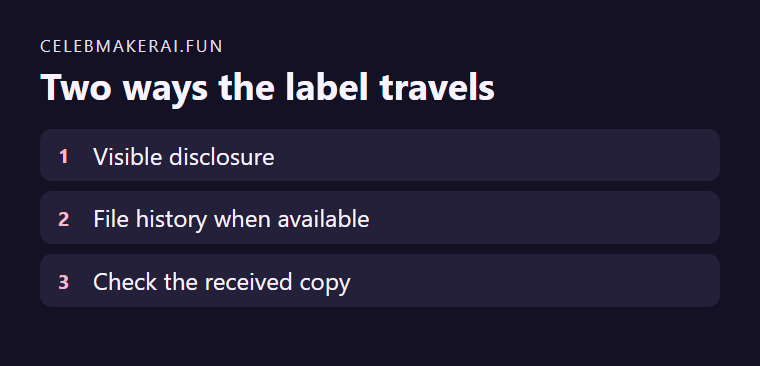
Recheck the version the next person sees
Open the file sent in the handoff and confirm that the disclosure still applies. If the editing chain supplies Content Credentials, inspect the available history for that output. An absent credential gives no positive proof that an image is original, and a credential does not establish that a person agreed to the use.
Review permissions separately if a real adult supplied the source. For example, Adobe Stock’s contributor guidance treats required releases and third-party rights as distinct upload checks. Keep a private record of what was approved and where the resulting image may appear.
Give the next recipient a usable caption, the intended publication context and an exact version. If a later editor changes the face or swaps the setting, they can update the disclosure for that new file.